Summary
Definition
History and exam
Other diagnostic factors
- symptoms of hypogonadotrophic hypogonadism (amenorrhoea, erectile dysfunction)
- headache
- symptoms of intracranial hypertension (nausea, vomiting, decreased sensorium, diplopia)
- galactorrhoea
- optic atrophy
- polyuria/polydipsia
Diagnostic investigations
1st investigations to order
- ophthalmological evaluation; computerised visual-field examination
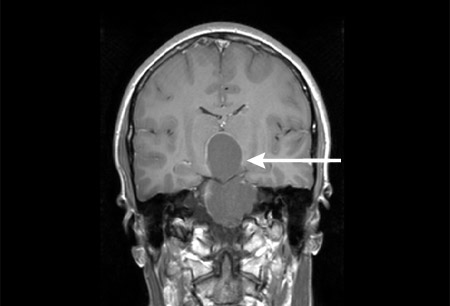
- MRI brain (contrast-enhanced)
- CT brain (contrast-enhanced)
- serum prolactin
- serum insulin-like growth factor 1
- growth hormone (GH) stimulation test
- serum luteinising hormone
- serum follicle-stimulating hormone
- morning serum testosterone
- serum thyroid-stimulating hormone (TSH) and free thyroxine (FT4)
- morning serum cortisol and adrenocorticotrophic hormone (ACTH)
- serum electrolytes
- urine and serum osmolality
- plain x-rays for bone age
Investigations to consider
- adrenocorticotropic hormone (ACTH) stimulation test
- tissue histology
Treatment algorithm
Contributors
Authors
Olabisi Sanusi, MD
Assistant Professor (Skull Base and Open cerebrovascular)
Departments of Neurosurgery, Otolaryngology
Director of Diversity, Equity, and Inclusion
Co-director Skull base fellowship
Oregon Health & Science University
Portland
OR
Disclosures
OS has given lectures related to Craniopharyngioma at the Congress of Neurological Surgeons meeting 2023, and will be giving another at the National Association of Skull Base Surgeons Meeting 2025.
Acknowledgements
Dr Olabisi Sanusi would like to gratefully acknowledge Dr Marc C. Chamberlain and Dr Daniel L. Silbergeld, the previous contributors to this topic.
Disclosures
MCC and DLS declare that they have no competing interests.
Peer reviewers
Edwin S. Kulubya Jr., MD, MBA
Neurosurgical Research Fellow
UC Davis Medical Center
Sacramento
CA
Disclosures
EK declares that he has no competing interests.
Ramez Kirollos, MBChB, FRCS(Ed), FRCS(Eng), MD, FRCS(SN)
Consultant Neurosurgeon
Addenbrooke's Hospital
Cambridge University Hospitals NHS Foundation Trust
Cambridge
UK
Disclosures
RK declares that he has no competing interests.
Keyoumars Ashkan, BA, BSc, MB BCh, MRCP, FRCS, FRCPS, FRCS(SN), MD
Consultant Neurosurgeon and Lead of Neuro-Oncology
King's College Hospital
London
UK
Disclosures
KA declares that he has no competing interests.
Peer reviewer acknowledgements
BMJ Best Practice topics are updated on a rolling basis in line with developments in evidence and guidance. The peer reviewers listed here have reviewed the content at least once during the history of the topic.
Disclosures
Peer reviewer affiliations and disclosures pertain to the time of the review.
References
Key articles
Louis DN, Perry A, Wesseling P, et al. The 2021 WHO classification of tumors of the central nervous system: a summary. Neuro Oncol. 2021 Aug 2;23(8):1231-51.Full text Abstract
Karavitaki N, Cudlip S, Adams CB, et al. Craniopharyngiomas. Endocr Rev. 2006 Jun;27(4):371-97. Abstract
Gan HW, Morillon P, Albanese A, et al. National UK guidelines for the management of paediatric craniopharyngioma. Lancet Diabetes Endocrinol. 2023 Sep;11(9):694-706. Abstract
Hoffman LM, Jaimes C, Mankad K, et al. Response assessment in pediatric craniopharyngioma: recommendations from the Response Assessment in Pediatric Neuro-Oncology (RAPNO) Working Group. Neuro Oncol. 2023 Feb 14;25(2):224-33.Full text Abstract
Reference articles
A full list of sources referenced in this topic is available here.
Use of this content is subject to our disclaimer