Investigations
1st investigations to order
12-lead ECG
CXR
Test
Should be ordered in all patients with suspected myocarditis.[64] As a first-line investigation, CXR helps rule out pulmonary oedema and provides an initial assessment of cardiac silhouette and pulmonary vasculature.[16] In the context of acute heart failure due to myocarditis, CXR may reveal pulmonary congestion. Cardiomegaly can suggest associated myopericarditis with pericardial effusion or chronic myocarditis evolving into dilated cardiomyopathy.
Result
frequently reveals bilateral pulmonary infiltrates in the setting of myocarditis-induced CHF; may show pulmonary oedema or cardiomegaly
serum CK
Test
Should be ordered immediately when evaluating anyone with suspected myocardial injury.
Result
often mildly elevated
serum CK-MB
Test
Should be ordered immediately when evaluating anyone with suspected myocardial injury.
Result
often mildly elevated
serum troponin (I or T)
Test
Should be ordered immediately when evaluating anyone with suspected myocardial injury. Troponin (I or T) levels have been shown to be a more reliable indicator of myocardial damage than creatine kinase-MB and creatine kinase, including in children.[15][16] However, it should be noted that some patients with myocarditis do not have elevated high-sensitivity cardiac troponin levels.[56]
Result
elevated
serum B-type natriuretic peptide
Test
May be helpful in distinguishing primary cardiac from primary pulmonary aetiologies of dyspnoea when the physical examination and initial work-up is unclear or non-specific.[59] Is best used to support the history and physical examination.
Result
elevated in response to ventricular distention, such as occurs in CHF due to myocarditis
two-dimensional echocardiogram
Test
Should be ordered in every patient suspected of having myocarditis.[15][16][57] Special attention should be paid to evaluation for clots which can change therapies and risk profile.[Figure caption and citation for the preceding image starts]: Apical 4-chamber transthoracic echocardiogram in a patient with myocarditis. The right ventricle is dilated with hypokinesis. Triscupid regurgitation is present with a reduced continuous wave Doppler gradient indicating right ventricular failureFrom: Rasmussen TB, Dalager S, Andersen NH, et al. BMJ Case Reports 2009; doi:10.1136/bcr.09.2008.0997 [Citation ends]. [Figure caption and citation for the preceding image starts]: Apical 4-chamber echocardiogram in a patient presenting with myocarditis showing a slightly dilated left ventricle with spontaneous ultrasonic contrast indicating severely impaired left ventricular systolic functionFrom: Rasmussen TB, Dalager S, Andersen NH, et al. BMJ Case Reports 2009; doi:10.1136/bcr.09.2008.0997 [Citation ends].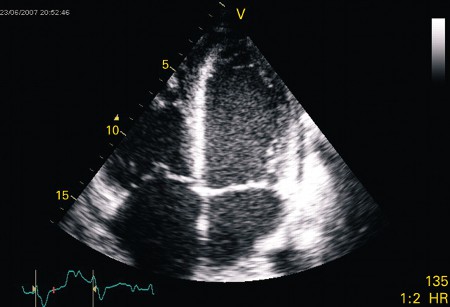
Result
global and regional left ventricular motion abnormalities and dilatation
Investigations to consider
endomyocardial biopsy (EMB)
Test
Recommendations on which patients should undergo EMB vary and local guidelines should be consulted.[5][58][59][60][61][66][67] The potential risks and benefits of EMB should always be carefully assessed, particularly during the acute presentation, as the risk of arrhythmia or ventricular perforation is highest at this time.
The American College of Cardiology (ACC) recommends EMB in adults with suspected: asymptomatic (stage B) myocarditis in the setting of immune checkpoint inhibitor therapy; symptomatic (stage C) myocarditis with left ventricular dysfunction, symptomatic heart failure, arrhythmia, peripheral eosinophilia, or when the diagnosis is uncertain and cardiac MRI cannot be obtained; most patients with advanced (stage D) myocarditis.[56]
The ACC recommends against EMB for low-risk adults patients with stage C myocarditis (i.e., symptomatic myocarditis with normal left ventricular ejection fraction, haemodynamic and electrical stability, and no or minimal late gadolinium enhancement) and adults patients with stage B myocarditis that is not due to immune checkpoint inhibitor therapy.[56]
A statement on dilated cardiomyopathies from the American Heart Association (AHA) recommends biopsy in adults 'with clinically suspected unexplained acute myocarditis who require inotropic support or mechanical circulatory support and those with Mobitz type 2 second-degree or higher heart block, sustained or symptomatic ventricular tachycardia, or failure to respond to guideline-based medical management within 1-2 weeks'.[58] The 2022 AHA/American College of Cardiology/Heart Failure Society of America (HFSA) adult heart failure (HF) guidelines state 'endomyocardial biopsy may be advantageous in patients with heart failure in which a histological diagnosis, such as myocarditis, may influence treatment decisions'.[59] A joint statement from Heart Failure Association of European Society of Cardiology (ESC), HFSA, and Japanese HF Society recommends EMB 'in patients with fulminant/acute myocarditis presenting with cardiogenic shock or acute HF and left ventricular (LV) dysfunction, with or without malignant ventricular arrhythmias and/or conduction abnormalities'. They also recommend considering EMB in 'haemodynamically stable patients with clinical symptoms and diagnostic criteria (electrocardiographic abnormalities, elevated troponin levels, imaging findings) suggestive of myocarditis, in the absence of significant coronary artery disease'.[61]
In children, cardiac MRI has replaced traditional EMB as the preferred diagnostic modality because it is non-invasive.[15] However, EMB retains specific indications, particularly in confirming diagnoses such as lymphocytic myocarditis, hypersensitivity myocarditis, and giant cell myocarditis, where histopathological evaluation directly informs clinical management. Immunohistochemistry has greatly increased the ability to assess for inflammatory cells.[15]
[Figure caption and citation for the preceding image starts]: Histological findings in a patient with giant cell myocarditis. A: severe myocardial necrosis and fibrotic replacement of the cardiomyocytes with granulation tissue and fibrosis is present in a section from the anterolateral left ventricular wall; B: a sharp demarcating border between vital and necrotic myocardium is seen, confirmed by additional immunohistochemical staining for myoglobin; C: at the inflammatory border, cells consisting of prominent multi-nucleated giant cells, macrophages, lymphocytes, and eosinophilic granulocytes are seen in close proximity to vital myocardium; D: immunohistochemical staining for complement 4d is positive in all vessels, suggestive of complement cascade activationFrom: Rasmussen TB, Dalager S, Andersen NH, et al. BMJ Case Reports 2009; doi:10.1136/bcr.09.2008.0997 [Citation ends].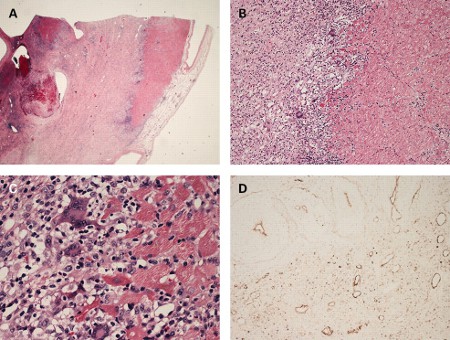
Result
histopathological findings of myocardial cellular infiltrates ± myocardial necrosis
coronary angiography
Test
Should be performed when the presenting symptoms and findings are indistinguishable from the acute coronary syndromes.
Result
normal or insignificant findings on coronary angiography are common in myocarditis and rule out MI
18F-fluorodeoxyglucose positron emission tomography-computed tomography (FDG PET-CT)
Test
Helps diagnose myocarditis by providing metabolic information of inflammation as increased FDG uptake. FDG PET-CT is useful in chronic myocarditis, where cardiac magnetic resonance does not have the same accuracy as in acute myocarditis.[71]
FDG PET-CT is also a valuable diagnostic tool for cardiac sarcoidosis and can facilitate differentiation from giant cell myocarditis.[72] In cardiac sarcoidosis presenting with myocarditis, FDG PET-CT typically reveals tracer uptake in the lungs, lymph nodes, and myocardial tissue. In addition, FDG PET-CT can help detect myocarditis in the context of systemic autoimmune diseases, where abnormal tracer accumulation may be seen in the myocardium as well as other involved organs, such as the aortic wall in certain forms of vasculitis.[67]
Result
detection of inflammation
cardiac MRI
Test
Can be performed when trying to distinguish between myocarditis and ischaemic heart disease using typical findings on MRI.[16][57][62] In some cases, findings from cardiac MRI can also be useful in determining the aetiology of myocarditis.[69]
Lake Louise consensus criteria were updated in 2018 to propose that presence of both T2 and T1 findings provide strong evidence for myocardial inflammation.[70]
In children, cardiac MRI has replaced EMB as the preferred diagnostic modality because it is non-invasive.[15] The primary purpose of cardiac MRI in children is to identify myocardial injury, and to differentiate acute myocarditis from non-inflammatory cardiomyopathies.[15]
Result
global early enhancement suggests myocarditis where late gadolinium enhancement suggests myocardial ischaemia or scar; presence of concurrent pericardial thickening or inflammation
viral polymerase chain reaction (PCR)
genetic testing
Test
Genetic predisposition is increasingly recognised as a risk factor for myocarditis.[55] The ACC recommends genetic counselling and testing for all consenting patients, followed by cascade screening of family members if a pathogenic variant is identified to facilitate early detection, surveillance, and management of at-risk relatives.[56]
Result
may identify pathogenic variants
Emerging tests
MRI-guided EMB
Test
Still in the developmental phase and requires validation in larger studies.
MRI-guided EMB is a promising new technology that appears to significantly increase the sensitivity of EMB in the diagnosis of myocarditis.[73]
Result
histopathological findings of myocardial cellular infiltrates ± myocardial necrosis
Use of this content is subject to our disclaimer