Approach
Patients often present with critical ischaemia and need admission to hospital at the time of diagnosis. Critical ischaemia is defined as gangrene or rest pain lasting >2 weeks and requiring regular opioid analgesia. Its definition may also include ankle pressure <50 mmHg. Patients with non-critical ischaemia present with either claudication or new onset of rest pain.
Initial admission to the hospital involves confirming diagnosis, excluding differential diagnosis, and arterial imaging. Vasoactive dilation is done during initial admission to hospital, along with debridement of any gangrenous tissue. Further treatments are given depending on severity of ischaemia and degree of pain.
Smoking cessation
Smoking cessation reduces the incidence of amputation.[2][5] It improves patency and limb salvage rates in those who do undergo surgical revascularisation.[35][36] From a group of 43 patients who stopped smoking, 94% avoided an amputation.[34] Patients who continue to smoke have a 19% major amputation rate; this is 2.73 times greater than for people who have ceased smoking, according to one study.[36][37][Figure caption and citation for the preceding image starts]: A cold, ischaemic middle finger in a woman who smokesFrom the collection of Matthew J. Metcalfe and Alun H. Davies [Citation ends].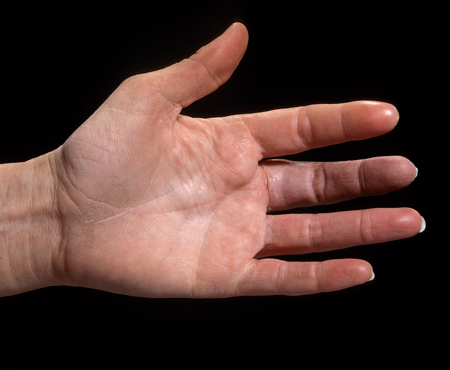 [Figure caption and citation for the preceding image starts]: Subsequent middle finger amputation in a woman who continued to smokeFrom the collection of Matthew J. Metcalfe and Alun H. Davies [Citation ends].
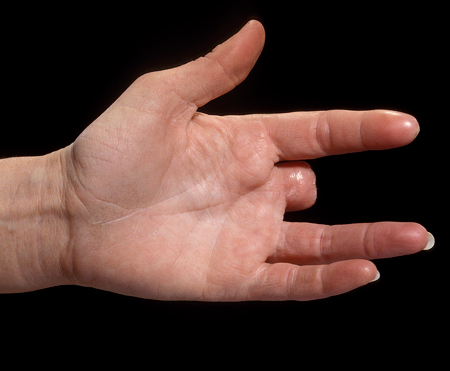 [Figure caption and citation for the preceding image starts]: Subsequent index finger amputation in a woman who continued to smokeFrom the collection of Matthew J. Metcalfe and Alun H. Davies [Citation ends].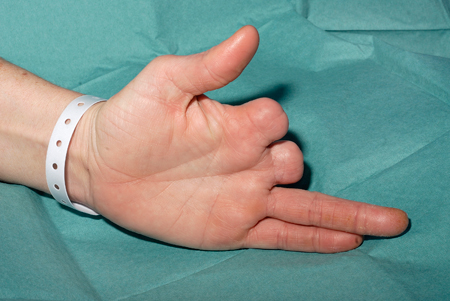
Smoking increases flare-ups and reduces ulcer healing. A return to smoking following cessation may lead to a flare-up of the disease.
Smoking only one or two cigarettes a day, using smokeless tobacco (chewing tobacco), or using nicotine replacement therapy may all keep the disease active.[19][20]
See Smoking cessation.
Additional therapies
Several additional therapies have shown some benefit, but the definitive treatment for Buerger's disease is smoking cessation.
Vasoactive drugs
Nifedipine, a calcium-channel blocker, may cause peripheral vasodilation and improve distal blood flow.[5] It has been shown to be of benefit in patients with lower limb trophic changes and symptoms, and is often given in combination with other therapies such as cessation of smoking, antibiotics, and iloprost.[38][39]
Pentoxifylline and cilostazol have had good effects, although there are few supportive data. They are not routinely used. Pentoxifylline has been shown to improve pain and healing in ischaemic ulcers.[40] Treatment with pentoxifylline can be tried after other medical therapies have failed. Cilostazol could be tried in conjunction with or following failure of other medical therapies (e.g., nifedipine).[41] It is contra-indicated in the following: patients with unstable angina, recent myocardial infarction, or coronary intervention (within 6 months); patients receiving two or more other antiplatelet agents or anticoagulants; and patients with history of severe tachyarrhythmia.
Iloprost is a prostacyclin analogue that may be given intravenously. It has been shown to be beneficial in relieving rest pain and in healing 62% of ulcers within 4 weeks following a 24-day course.[42][43] The effects of intravenous iloprost and alprostadil have been compared and showed no significant difference between them, suggesting they are both beneficial at healing ulcers and resolving rest pain at 28 days. However, the quality of evidence in these studies was low to very low.[44] Intravenous iloprost induces peripheral vasodilatation in conditions such as Raynaud’s phenomenon and systemic sclerosis (scleroderma). Small studies have suggested it may reduce rest pain in Buerger’s disease.[45] Improved rates of ulcer healing and walking distance have also been reported.[46] However, iloprost, when given orally, shows little significant benefit in regards to ulcer healing, pain, and amputation rates.[47]
Antibiotics
The choice of antibiotics depends on local hospital policies. Antibiotics are indicated only in the presence of infection or wet gangrene. Aerobic and anaerobic cover is needed. Amoxicillin/clavulanate may be adequate, or a penicillin plus metronidazole, or ciprofloxacin (if Pseudomonas is present), or a third-generation cephalosporin plus metronidazole. If admission to hospital is recommended (when patients present with critical ischaemia), the antibiotics can be given intravenously.
Systemic fluoroquinolone antibiotics, such as ciprofloxacin, may cause serious, disabling, and potentially long-lasting or irreversible adverse events. This includes, but is not limited to: tendinopathy/tendon rupture; peripheral neuropathy; arthropathy/arthralgia; aortic aneurysm and dissection; heart valve regurgitation; dysglycaemia; and central nervous system effects including seizures, depression, psychosis, and suicidal thoughts and behaviour.[48]
Prescribing restrictions apply to the use of fluoroquinolones, and these restrictions may vary between countries. In general, fluoroquinolones should be restricted for use in serious, life-threatening bacterial infections only. Some regulatory agencies may also recommend that they must only be used in situations where other antibiotics, that are commonly recommended for the infection, are inappropriate (e.g., resistance, contraindications, treatment failure, unavailability).
Consult your local guidelines and drug formulary for more information on suitability, contraindications, and precautions.
Analgesia
For acute ischaemic pain, paracetamol and an opioid (weak or strong) are recommended, depending on the severity of pain.[49] Severe pain requiring analgesia often requires admission to hospital so that disease can be controlled or the extent of disease can be assessed.
Non-steroidal anti-inflammatory drugs (NSAIDs) can be used to treat superficial venous thrombophlebitis. Admission to hospital is not a requirement for giving NSAIDs but may occur if several medical options are being tried while observing disease severity.
Spinal cord stimulation may also be beneficial. It has been shown to benefit patients with lower limb symptoms ranging from claudication and pain to ulceration and trophic changes. It is often used after medical therapy has failed. Spinal cord stimulation is performed by an implantable stimulator.[50][51][52]
Sympathectomy
This can be chemical or surgical, lumbar, or thoracoscopic. Both positive and negative results have been reported with lumbar sympathectomy.[43][53] Sympathectomy may be sufficient to enable necrotic lesions to heal.[54] It is thought to reduce pain by reducing peripheral resistance and promoting collateral development.[55] Thoracoscopic sympathectomy can be used for upper limb symptoms, and lumbar sympathectomy for lower limb symptoms. Due to the invasiveness of the procedure, sympathectomy is often a treatment tried when medical therapy has failed and there is no revascularisation option. It is often used in the more severe cases where there is tissue loss. However, its use has been reported in patients presenting with claudication.[56]
Surgical revascularisation
Due to the lack of patent distal vessels, bypass is often not an option. Angiography may reveal potential distal anastomotic sites, allowing bypass to help ulcer healing. However, primary graft patency rates are 41% at 1 year, 32% at 5 years, and 30% at 10 years; secondary patency rates are 54% at 1 year, 47% at 5 years, and 39% at 20 years.[36]
Surgical revascularisation is indicated mainly in patients with critical ischaemia. Patients with non-critical ischaemia are only indicated for surgical revascularisation if there is severe claudication and a good vessel to anastomose onto distally.
Amputation
If part of a limb is clearly non-viable from the outset or attempts at revascularisation should fail, amputation is required. Careful consideration of the most appropriate type and level of amputation should be made in consultation with the patient, bearing in mind factors such as likelihood of successful healing, patient motivation and social circumstances, and the patient's potential functional outcomes with an appropriate prosthesis, if required.
In one study, 34% of patients had an amputation within 15 years of diagnosis.[2] The amputation-free survival rates at 5 and 10 years were 85% and 74%, respectively. Limb infection was associated with an increased amputation rate.[2]
Use of this content is subject to our disclaimer