The critical components to the diagnosis of an absence epilepsy syndrome are a detailed description of the patient's unusual episodes and the EEG characteristics.
History
A detailed description of the unusual episode is essential, preferably from witnesses as well as the patient. A video recording of an episode can be very useful. Important features to assess include:[9]Hirsch E, French J, Scheffer IE, et al. ILAE definition of the idiopathic generalized epilepsy syndromes: position statement by the ILAE task force on nosology and definitions. Epilepsia. 2022 Jun;63(6):1475-99.
https://onlinelibrary.wiley.com/doi/10.1111/epi.17236
http://www.ncbi.nlm.nih.gov/pubmed/35503716?tool=bestpractice.com
[29]Guilhoto LM. Absence epilepsy: continuum of clinical presentation and epigenetics? Seizure. 2017 Jan;44:53-7.
https://www.seizure-journal.com/article/S1059-1311(16)30299-0/fulltext
http://www.ncbi.nlm.nih.gov/pubmed/27986418?tool=bestpractice.com
[30]Albuja AC, Ighodaro ET, Khan GQ. Absence seizure. Treasure Island (FL): StatPearls Publishing; 2025.
Patient's activity at onset: behavioural arrest or staring; interruption of otherwise normal activity
Simple or complex automatisms: any associated movements of eyes, face, and hands[31]Sadleir LG, Scheffer IE, Smith S,et al. Automatisms in absence seizures in children with idiopathic generalized epilepsy. Arch Neurol. 2009 Jun;66(6):729-34.
http://www.ncbi.nlm.nih.gov/pubmed/19506132?tool=bestpractice.com
The duration of an event: typically lasting 5 to 10 seconds (range from 3 to 20 seconds)
The frequency of events: several per day, but may be under-recognised
No aura and minimal to no postictal state should occur
Age of onset; childhood absence epilepsy (CAE) has a typical age of onset between 4 and 10 years of age is pathognomonic, and juvenile myoclonic epilepsy (JME) has a typical age of onset between 9 and 13 years.
Birth and developmental history, including specifically any history of learning disabilities or behavioural problems such as attention deficit hyperactivity disorder (ADHD), as well as any history of seizures of any type, are also significant in considering the specific classification of the electroclinical syndrome.
Family history should be ascertained. Key risk factors for the development of absence seizure include family history of CAE or JME.[9]Hirsch E, French J, Scheffer IE, et al. ILAE definition of the idiopathic generalized epilepsy syndromes: position statement by the ILAE task force on nosology and definitions. Epilepsia. 2022 Jun;63(6):1475-99.
https://onlinelibrary.wiley.com/doi/10.1111/epi.17236
http://www.ncbi.nlm.nih.gov/pubmed/35503716?tool=bestpractice.com
Physical Examination
For CAE, juvenile absence epilepsy (JAE), and JME, a patient should typically have an entirely normal physical examination. However, hyperventilation is an easily performed manoeuvre that often will trigger absence seizures and can be diagnostic on clinical grounds.[9]Hirsch E, French J, Scheffer IE, et al. ILAE definition of the idiopathic generalized epilepsy syndromes: position statement by the ILAE task force on nosology and definitions. Epilepsia. 2022 Jun;63(6):1475-99.
https://onlinelibrary.wiley.com/doi/10.1111/epi.17236
http://www.ncbi.nlm.nih.gov/pubmed/35503716?tool=bestpractice.com
[30]Albuja AC, Ighodaro ET, Khan GQ. Absence seizure. Treasure Island (FL): StatPearls Publishing; 2025.
If the patient has evidence of cognitive impairment or abnormalities in muscle tone or tendon reflexes, an epilepsy syndrome associated with an identifiable aetiology (e.g., genetic, structural, metabolic), such as Lennox-Gastaut syndrome (LGS), is probable. Abnormal physical or cognitive findings indicate the need for further diagnostic work-up, such as brain MRI or metabolic and genetic testing.
EEG
An EEG should be ordered in the initial assessment of all patients. The EEG should be conducted when the patient is sleep deprived, to include those periods of time when the patient is alternately awake and asleep.[32]Koutroumanidis M, Arzimanoglou A, Caraballo R, et al. The role of EEG in the diagnosis and classification of the epilepsy syndromes: a tool for clinical practice by the ILAE Neurophysiology Task Force (Part 2). Epileptic Disord. 2017 Dec 1;19(4):385-437.
http://www.ncbi.nlm.nih.gov/pubmed/29350182?tool=bestpractice.com
[33]Koutroumanidis M, Arzimanoglou A, Caraballo R, et al. The role of EEG in the diagnosis and classification of the epilepsy syndromes: a tool for clinical practice by the ILAE Neurophysiology Task Force (Part 1). Epileptic Disord. 2017 Sep 1;19(3):233-98.
http://www.ncbi.nlm.nih.gov/pubmed/28984246?tool=bestpractice.com
[34]Harvey S, Shahwan A. Typical absence seizures in children: review with focus on EEG predictors of treatment response and outcome. Seizure. 2023 Aug;110:1-10.
http://www.ncbi.nlm.nih.gov/pubmed/37295276?tool=bestpractice.com
It is essential to ask the patient to hyperventilate for 3 minutes in order to induce an absence seizure, a diagnostic finding.
The EEG may be repeated to assess treatment response in patients with CAE.[34]Harvey S, Shahwan A. Typical absence seizures in children: review with focus on EEG predictors of treatment response and outcome. Seizure. 2023 Aug;110:1-10.
http://www.ncbi.nlm.nih.gov/pubmed/37295276?tool=bestpractice.com
There is some suggestion that normalisation of EEG correlates with greater likelihood of resolution of CAE. Patients with longer seizures at baseline may have more favourable initial treatment response, but are at greater risk for inattention.[35]Dlugos D, Shinnar S, Cnaan A, et al. Pretreatment EEG in childhood absence epilepsy: associations with attention and treatment outcome. Neurology. 2013 Jul 9;81(2):150-6.
http://www.ncbi.nlm.nih.gov/pubmed/23719147?tool=bestpractice.com
For typical absence seizures, a classic 3 Hz generalised spike-and-wave pattern, often activated by hyperventilation, is considered the most specific and sensitive test confirming a diagnosis of absence seizures.[34]Harvey S, Shahwan A. Typical absence seizures in children: review with focus on EEG predictors of treatment response and outcome. Seizure. 2023 Aug;110:1-10.
http://www.ncbi.nlm.nih.gov/pubmed/37295276?tool=bestpractice.com
[Figure caption and citation for the preceding image starts]: 3 Hz generalised spike-and-wave pattern on EEG pathognomonic for typical absence seizures and childhood absence epilepsyFrom the personal collection of Dr M. Wong; used with permission [Citation ends].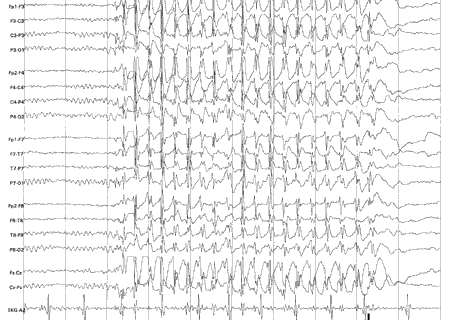 For atypical absence seizures, a slow (<2.5 Hz) generalised spike-and-wave pattern is characteristic.[14]Specchio N, Wirrell EC, Scheffer IE, et al. International league against epilepsy classification and definition of epilepsy syndromes with onset in childhood: position paper by the ILAE task force on nosology and definitions. Epilepsia. 2022 Jun;63(6):1398-442.
https://onlinelibrary.wiley.com/doi/10.1111/epi.17241
http://www.ncbi.nlm.nih.gov/pubmed/35503717?tool=bestpractice.com
[34]Harvey S, Shahwan A. Typical absence seizures in children: review with focus on EEG predictors of treatment response and outcome. Seizure. 2023 Aug;110:1-10.
http://www.ncbi.nlm.nih.gov/pubmed/37295276?tool=bestpractice.com
[Figure caption and citation for the preceding image starts]: Slow (<2.5 Hz) generalised spike-and-wave on EEG associated with atypical absence seizures and Lennox-Gastaut syndromeFrom the personal collection of Dr M. Wong; used with permission [Citation ends].
For atypical absence seizures, a slow (<2.5 Hz) generalised spike-and-wave pattern is characteristic.[14]Specchio N, Wirrell EC, Scheffer IE, et al. International league against epilepsy classification and definition of epilepsy syndromes with onset in childhood: position paper by the ILAE task force on nosology and definitions. Epilepsia. 2022 Jun;63(6):1398-442.
https://onlinelibrary.wiley.com/doi/10.1111/epi.17241
http://www.ncbi.nlm.nih.gov/pubmed/35503717?tool=bestpractice.com
[34]Harvey S, Shahwan A. Typical absence seizures in children: review with focus on EEG predictors of treatment response and outcome. Seizure. 2023 Aug;110:1-10.
http://www.ncbi.nlm.nih.gov/pubmed/37295276?tool=bestpractice.com
[Figure caption and citation for the preceding image starts]: Slow (<2.5 Hz) generalised spike-and-wave on EEG associated with atypical absence seizures and Lennox-Gastaut syndromeFrom the personal collection of Dr M. Wong; used with permission [Citation ends].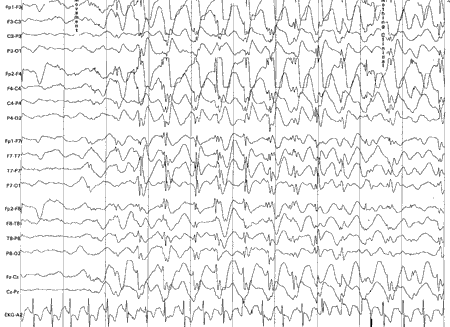
Magnetic resonance imaging (MRI) brain
A MRI scan is required only if the history, clinical course, physical examination. or EEG findings do not fit with typical absence seizures or generalised epilepsy syndromes.
Metabolic testing
Metabolic tests are generally indicated when the clinical and EEG findings do not fit with typical absence seizures or typical epilepsy syndromes, but suggest a symptomatic aetiology. There are a broad variety of metabolic tests that can be performed and these need to be tailored to the individual patient. Possible metabolic disorders causing atypical absence seizures include aminoacidurias, organic acidurias, mitochondrial disorders, and lysosomal storage diseases.[36]Hirtz D, Ashwal S, Berg A, et al. Practice parameter: evaluating a first nonfebrile seizure in children (reaffirmed 2023). Neurology. 2000 JSep 12;55(5):616-23.
http://www.neurology.org/content/55/5/616.full
http://www.ncbi.nlm.nih.gov/pubmed/10980722?tool=bestpractice.com
Testing of cerebrospinal fluid glucose and serum glucose should be considered for patients with typical absence seizures that began before age 4 years or with intractable absence epilepsy, to evaluate for glucose transporter type 1 deficiency syndrome (GLUT1-DS).[26]Mullen SA, Suls A, De Jonghe P, et al. Absence epilepsies with widely variable onset are a key feature of familial GLUT1 deficiency. Neurology. 2010 Aug 3;75(5):432-40.
http://www.ncbi.nlm.nih.gov/pubmed/20574033?tool=bestpractice.com
Genetic testing
For typical absence seizures associated with a genetic generalised epilepsy such as CAE or JME, genetic testing is not routinely recommended because there is presumed complex inheritance potentially involving multiple genes. In CAE, pathogenic variants have been infrequently reported in several genes including GABRG2, GABRA1, and SCN1A.[9]Hirsch E, French J, Scheffer IE, et al. ILAE definition of the idiopathic generalized epilepsy syndromes: position statement by the ILAE task force on nosology and definitions. Epilepsia. 2022 Jun;63(6):1475-99.
https://onlinelibrary.wiley.com/doi/10.1111/epi.17236
http://www.ncbi.nlm.nih.gov/pubmed/35503716?tool=bestpractice.com
[37]Mullen SA, Berkovic SF, ILAE Genetics Commission. Genetic generalized epilepsies. Epilepsia. 2018 Jun;59(6):1148-53.
https://onlinelibrary.wiley.com/doi/10.1111/epi.14042
http://www.ncbi.nlm.nih.gov/pubmed/29741207?tool=bestpractice.com
Genetic testing may be considered in certain situations, such as in patients with developmental delays, intellectual disability or autistic spectrum disorder, those with drug-resistant seizures, or in patients with a family history of epilepsy. Patients in whom onset of absence seizures occurs before age 4 years should be tested for GLUT1 deficiency, because 10% of these patients will have pathogenic variants in SCL2A1 resulting in GLUT1-DS.[9]Hirsch E, French J, Scheffer IE, et al. ILAE definition of the idiopathic generalized epilepsy syndromes: position statement by the ILAE task force on nosology and definitions. Epilepsia. 2022 Jun;63(6):1475-99.
https://onlinelibrary.wiley.com/doi/10.1111/epi.17236
http://www.ncbi.nlm.nih.gov/pubmed/35503716?tool=bestpractice.com
[26]Mullen SA, Suls A, De Jonghe P, et al. Absence epilepsies with widely variable onset are a key feature of familial GLUT1 deficiency. Neurology. 2010 Aug 3;75(5):432-40.
http://www.ncbi.nlm.nih.gov/pubmed/20574033?tool=bestpractice.com
[38]Byrne S, Kearns J, Carolan R, et al. Refractory absence epilepsy associated with GLUT-1 deficiency syndrome. Epilepsia. 2011 May;52(5):1021-4.
http://www.ncbi.nlm.nih.gov/pubmed/21366555?tool=bestpractice.com
In instances with a characteristic family history of other generalised epilepsies (generalised epilepsy with febrile seizures plus [GEFS+]), commercial testing for SCN1A gene mutations may be indicated. As more genes are identified for these syndromes, this may become more common. Genetic testing should also be considered in patients with developmental epileptic encephalopathies and neurodevelopmental disabilities, including syndromes involving atypical absence seizures such as LGS.[14]Specchio N, Wirrell EC, Scheffer IE, et al. International league against epilepsy classification and definition of epilepsy syndromes with onset in childhood: position paper by the ILAE task force on nosology and definitions. Epilepsia. 2022 Jun;63(6):1398-442.
https://onlinelibrary.wiley.com/doi/10.1111/epi.17241
http://www.ncbi.nlm.nih.gov/pubmed/35503717?tool=bestpractice.com
[39]Sheidley BR, Malinowski J, Bergner AL, et al. Genetic testing for the epilepsies: a systematic review. Epilepsia. 2022 Feb;63(2):375-87.
http://www.ncbi.nlm.nih.gov/pubmed/34893972?tool=bestpractice.com