History and exam
Key diagnostic factors
common
presence of risk factors
Key risk factors are low dietary folate intake; age >65 years; alcohol-use disorder; pregnancy or lactation; prematurity; intestinal malabsorption disorders; use of trimethoprim, methotrexate, anticonvulsants, sulfasalazine, or pyrimethamine; infantile intake of goats' milk; and congenital defects in folate absorption and metabolism.
Other diagnostic factors
common
prolonged diarrhoea
Chronic diarrhoeal states (such as tropical sprue and coeliac disease [non-tropical sprue]) and inflammatory bowel disease lead to poor absorption of folate.
loss of appetite and weight loss
Common symptoms accompanying severe folate deficiency.
Weight loss is an objective vital sign in megaloblastic anaemia that results from both loss of appetite and increased energy demands of ineffective erythropoiesis.
fatigue
A symptom of anaemia.
In early folate deficiency states, the haemoglobin and mean corpuscular volume are normal. As the deficiency progresses, haemoglobin reduces, leading to anaemia.
shortness of breath
A symptom of anaemia.
In early folate deficiency states, the haemoglobin and mean corpuscular volume are normal. As the deficiency progresses, haemoglobin reduces, leading to anaemia.
dizziness
A symptom of anaemia.
In early folate deficiency states, the haemoglobin and mean corpuscular volume are normal. As the deficiency progresses, haemoglobin reduces, leading to anaemia.
pallor
A symptom of anaemia.
In early folate deficiency states, the haemoglobin and mean corpuscular volume are normal. As the deficiency progresses, haemoglobin reduces, leading to anaemia.
headache
A symptom of anaemia.
In early folate deficiency states, the haemoglobin and mean corpuscular volume are normal. As the deficiency progresses, haemoglobin reduces, leading to anaemia.
tachycardia
May occur with anaemia.
In early folate deficiency states, the haemoglobin and mean corpuscular volume are normal. As the deficiency progresses, haemoglobin reduces, leading to anaemia.
tachypnoea
May occur with anaemia.
In early folate deficiency states, the haemoglobin and mean corpuscular volume are normal. As the deficiency progresses, haemoglobin reduces, leading to anaemia.
heart murmur
May occur with anaemia.
In early folate deficiency states, the haemoglobin and mean corpuscular volume are normal. As the deficiency progresses, haemoglobin reduces, leading to anaemia.
signs of heart failure
Signs include displaced apical impulse, gallop rhythm, and raised jugular venous pressure.
May occur in severe cases of folate deficiency.
signs of alcohol-use disorder
Examination may reveal signs of underlying disease associated with folate deficiency.
signs of haemolytic anaemia
Examination may reveal signs of underlying disease (including pallor, jaundice, systolic flow murmur, hepatosplenomegaly) associated with folate deficiency, but related to increased cell turnover.
signs of exfoliative dermatitis
Examination may reveal signs of underlying disease, mainly exfoliation of skin, associated with folate deficiency.
uncommon
painful swallowing
Severe deficiency can cause inflammation of the oral mucosa, which results in painful swallowing.
petechiae
Advanced deficiency can cause thrombocytopenia, which can result in development of petechiae.
glossitis
Severe deficiency can cause glossitis.
angular stomatitis
Severe deficiency can cause angular stomatitis.[Figure caption and citation for the preceding image starts]: Angular cheilitisFrom the collection of Dr Wanda C. Gonsalves; patient consent obtained [Citation ends].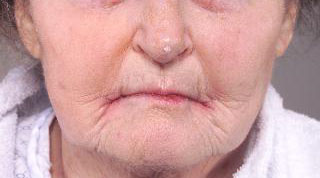
neurological deficits in children
Neurological signs and symptoms are not typically seen in patients with folate deficiency. Exceptions are children with inborn errors of folate absorption and metabolism, or those who have experienced severe antenatal folate deficiency, who often have severe myelopathy and neurological dysfunction.
Manifestations in the central nervous system are likely to be explained by the involvement of folate in the synthesis of methionine and S-adenosylmethionine, which are essential for normal development of the central nervous system. Vitamin B12 (cobalamin) deficiency may present as megaloblastic anaemia with neurological findings.
Risk factors
strong
low dietary folate intake
Folate intake can be inadequate for various reasons including insufficient daily consumption of folate-rich foods; consumption of unfortified cereals (e.g., rice, wheat, or corn) as a staple diet; exclusive consumption of goats’ milk (which is almost completely deficient in folate) by infants; excessive cooking of folate-rich foods (which destroys folate); or poor dietary intake during illness.[4][10][11][13]
Older people (aged >65 years), or people with an intellectual disability (who are living without assistance), are at increased risk for low dietary folate intake. In the prefortification era in the US, older people formed 10.8% of the folate-deficient population.[3]
alcohol-use disorder
Folate deficiency in chronic alcohol-use disorder is caused by multiple mechanisms, including low intake, poor absorption, reduced enterohepatic circulation and storage in the liver, and increased urinary excretion.[11]
Folate deficiency in people with alcohol-use disorder is rare in the US post-fortification.[22]
Most people consuming >80 g ethanol per day (about 1.5 litres of beer, 750 mL of wine, or 6 servings of distilled ethanol at 14 g/serving) have been found to be folate-deficient in the pre-fortification era.[23]
pregnant or lactating
prematurity
Red blood cell folate concentrations fall significantly in the first 2 to 3 months in preterm infants, whether breastfed or formula-fed.[27] Routine supplementation of folic acid for preterm infants is required.[28]
Folate levels are adequate in preterm infants fed modern formulas enriched with folic acid and in breastfed infants given folic acid supplements.[29]
intestinal malabsorptive disorders
Chronic diarrhoeal states (e.g., coeliac disease, tropical sprue, and inflammatory bowel disease), other intestinal disorders (e.g., malignant infiltration, amyloidosis, Whipple's disease, and scleroderma), and extensive resection of the small intestine can lead to poor absorption of folate.[30]
In the post-fortification era in the US, folate deficiency was found in 3.6% of newly diagnosed cases of coeliac disease compared with 0.3% of age-matched controls.[31]
use of certain drugs
Certain drugs (e.g., sulfasalazine, trimethoprim, methotrexate, pyrimethamine, and anticonvulsants [phenytoin, phenobarbital]) interfere with folate function or absorption by inhibiting enzymes involved in folate metabolism, and by other unknown mechanisms.[32]
congenital defects in folate absorption and metabolism
Rare, but potentially life-threatening.
Defects include hereditary folate malabsorption, methylenetetrahydrofolate reductase deficiency, glutamate formiminotransferase deficiency, and functional methionine synthase deficiency.
Presentation is often during infancy, with varying combinations of megaloblastic anaemia, failure to thrive, chronic diarrhoea, neurological deficits, and developmental delay.[12]
weak
states of increased cell turnover
Increased desquamation of cells in exfoliative dermatitis, and increased cell turnover in chronic haemolytic anaemias, can cause folate deficiency.
special diet
Patients with phenylketonuria are subject to strict dietary restrictions that may result in folate deficiency.
Use of this content is subject to our disclaimer