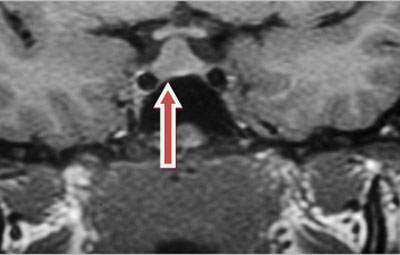
Hyperprolactinaemia is a condition of elevated serum prolactin (PRL). The level of PRL considered normal varies depending on the reference laboratory and type of immunoassay used, but it is commonly considered to be around <25 micrograms/L (<500 milliunits/L) in women and <20 micrograms/L (<400 milliunits/L) in men.[1]Leca BM, Mytilinaiou M, Tsoli M, et al. Identification of an optimal prolactin threshold to determine prolactinoma size using receiver operating characteristic analysis. Sci Rep. 2021 May 7;11(1):9801.
https://www.nature.com/articles/s41598-021-89256-7
http://www.ncbi.nlm.nih.gov/pubmed/33963239?tool=bestpractice.com
[2]Serri O, Chik CL, Ur E, et al. Diagnosis and management of hyperprolactinemia. CMAJ. 2003 Sep 16;169(6):575-81.
http://www.cmaj.ca/content/169/6/575.long
http://www.ncbi.nlm.nih.gov/pubmed/12975226?tool=bestpractice.com
[3]Mah PM, Webster J. Hyperprolactinemia: etiology, diagnosis, and management. Semin Reprod Med. 2002 Nov;20(4):365-74.
http://www.ncbi.nlm.nih.gov/pubmed/12536359?tool=bestpractice.com
Epidemiology
Hyperprolactinaemia is the most common endocrine disorder of the hypothalamus-pituitary axis. The prevalence of hyperprolactinaemia ranges from 0.4% in an unselected normal adult population to 26.8% in women and 2.1% in men undergoing fertility treatment.[4]Wojcik M, Amer S, Jayaprakasan K. The prevalence of hyperprolactinaemia in subfertile ovulatory women and its impact on fertility treatment outcome. J Obstet Gynaecol. 2022 Aug;42(6):2349-53.
http://www.ncbi.nlm.nih.gov/pubmed/35473513?tool=bestpractice.com
[5]Ambulkar SS, Darves-Bornoz AL, Fantus RJ, et al. Prevalence of hyperprolactinemia and clinically apparent prolactinomas in men undergoing fertility evaluation. Urology. 2022 Jan;159:114-9.
http://www.ncbi.nlm.nih.gov/pubmed/33766719?tool=bestpractice.com
It increases to 9% in women with amenorrhoea and occurs in 25% of those with galactorrhoea. Among women presenting with concomitant amenorrhoea and galactorrhoea, 70% are hyperprolactinaemic. The condition also accounts for 5% of men who present with impotence or infertility.[2]Serri O, Chik CL, Ur E, et al. Diagnosis and management of hyperprolactinemia. CMAJ. 2003 Sep 16;169(6):575-81.
http://www.cmaj.ca/content/169/6/575.long
http://www.ncbi.nlm.nih.gov/pubmed/12975226?tool=bestpractice.com
[3]Mah PM, Webster J. Hyperprolactinemia: etiology, diagnosis, and management. Semin Reprod Med. 2002 Nov;20(4):365-74.
http://www.ncbi.nlm.nih.gov/pubmed/12536359?tool=bestpractice.com
Although uncommon, hyperprolactinaemia can also present in children.
Pathophysiology
The hormone PRL is a 199-amino acid peptide synthesised and secreted by lactotroph cells in the anterior pituitary gland; 80% of circulating PRL exists as a 23 kilodalton (kD) monomer.[6]Vilar L, Abucham J, Albuquerque JL, et al. Controversial issues in the management of hyperprolactinemia and prolactinomas - an overview by the Neuroendocrinology Department of the Brazilian Society of Endocrinology and Metabolism. Arch Endocrinol Metab. 2018 Mar-Apr;62(2):236-63.
https://pmc.ncbi.nlm.nih.gov/articles/PMC10118988
http://www.ncbi.nlm.nih.gov/pubmed/29768629?tool=bestpractice.com
Dimeric PRL (also known as big PRL) has a molecular weight of 50 kD to 60 kD and accounts for 10% to 15%; the remainder is macroprolactin (also known as big-big PRL), a high molecular weight (>150 kD) complex of monomeric PRL and IgG.[7]Ben-Jonathan N, LaPensee CR, LaPensee EW. What can we learn from rodents about prolactin in humans? Endocr Rev. 2008 Feb;29(1):1-41.
https://academic.oup.com/edrv/article/29/1/1/2354965
http://www.ncbi.nlm.nih.gov/pubmed/18057139?tool=bestpractice.com
[8]Gibney J, Smith TP, McKenna TJ. Clinical relevance of macroprolactin. Clin Endocrinol (Oxf). 2005 Jun;62(6):633-43.
https://onlinelibrary.wiley.com/doi/full/10.1111/j.1365-2265.2005.02243.x
http://www.ncbi.nlm.nih.gov/pubmed/15943822?tool=bestpractice.com
PRL is also produced by numerous extrapituitary tissues, including various brain regions, lymphocytes, mammary epithelial cells, and tumours, as well as the decidua, myometrium, lacrimal gland, thymus, and spleen.[9]Bole-Feysot C, Goffin V, Edery M, et al. Prolactin (PRL) and its receptor: actions, signal transduction pathways and phenotypes observed in PRL receptor knockout mice. Endocr Rev. 1998 Jun;19(3):225-68.
https://academic.oup.com/edrv/article/19/3/225/2530791
http://www.ncbi.nlm.nih.gov/pubmed/9626554?tool=bestpractice.com
Although it derives from an ancestral hormone common to growth hormone and human placental lactogen, PRL displays little structural homology with these hormones.[7]Ben-Jonathan N, LaPensee CR, LaPensee EW. What can we learn from rodents about prolactin in humans? Endocr Rev. 2008 Feb;29(1):1-41.
https://academic.oup.com/edrv/article/29/1/1/2354965
http://www.ncbi.nlm.nih.gov/pubmed/18057139?tool=bestpractice.com
The main action of PRL is to stimulate breast epithelial cell proliferation and induce milk production. In addition to its lactogenic role, PRL promotes the formation and action of the corpus luteum and suppresses the pulsatile secretion of gonadotrophin-releasing hormone (GnRH). Suppression of GnRH by PRL results in decreased levels of follicle-stimulating hormone and luteinising hormone.[9]Bole-Feysot C, Goffin V, Edery M, et al. Prolactin (PRL) and its receptor: actions, signal transduction pathways and phenotypes observed in PRL receptor knockout mice. Endocr Rev. 1998 Jun;19(3):225-68.
https://academic.oup.com/edrv/article/19/3/225/2530791
http://www.ncbi.nlm.nih.gov/pubmed/9626554?tool=bestpractice.com
Moreover, PRL plays a direct inhibitory role in spermatogenesis and steroidogenesis, as its receptors have been detected in Sertoli and Leydig cells in the testes.[10]Arowojolu AO, Akinloye O, Shittu OB. Serum and seminal plasma prolactin levels in male attenders of an infertility clinic in Ibadan. J Obstet Gynaecol. 2004 Apr;24(3):306-9.
http://www.ncbi.nlm.nih.gov/pubmed/15203635?tool=bestpractice.com
PRL secretion is pulsatile and controlled predominantly by the inhibitory effect of dopamine released from the hypothalamus. Dopamine acts through its D2 receptors on lactotroph cells.[11]Petersenn S, Fleseriu M, Casanueva FF, et al. Diagnosis and management of prolactin-secreting pituitary adenomas: a Pituitary Society international consensus statement. Nat Rev Endocrinol. 2023 Dec;19(12):722-40.
https://www.nature.com/articles/s41574-023-00886-5
http://www.ncbi.nlm.nih.gov/pubmed/37670148?tool=bestpractice.com
Other inhibitory factors are endothelin peptides, tumour growth factor-beta 1, and calcitonin.[12]Kanyicska B, Lerant A, Freeman ME. Endothelin is an autocrine regulator of prolactin secretion. Endocrinology. 1998 Dec;139(12):5164-73.
https://academic.oup.com/endo/article/139/12/5164/2991322
http://www.ncbi.nlm.nih.gov/pubmed/9832457?tool=bestpractice.com
[13]Sarkar DK, Kim KH, Minami S. Transforming growth factor-beta 1 messenger RNA and protein expression in the pituitary gland: its action on prolactin secretion and lactotropic growth. Mol Endocrinol. 1992 Nov;6(11):1825-33.
http://www.ncbi.nlm.nih.gov/pubmed/1480172?tool=bestpractice.com
[14]Shah GV, Pedchenko V, Stanley S, et al. Calcitonin is a physiological inhibitor of prolactin secretion in ovariectomized female rats. Endocrinology. 1996 May;137(5):1814-22.
http://www.ncbi.nlm.nih.gov/pubmed/8612519?tool=bestpractice.com
Oestrogens stimulate the proliferation of lactotroph cells, resulting in an increased quantity of these cells in pre-menopausal women, especially during pregnancy. PRL production is also stimulated by thyrotropin-releasing hormone, vasoactive intestinal peptide, and oxytocin.[7]Ben-Jonathan N, LaPensee CR, LaPensee EW. What can we learn from rodents about prolactin in humans? Endocr Rev. 2008 Feb;29(1):1-41.
https://academic.oup.com/edrv/article/29/1/1/2354965
http://www.ncbi.nlm.nih.gov/pubmed/18057139?tool=bestpractice.com