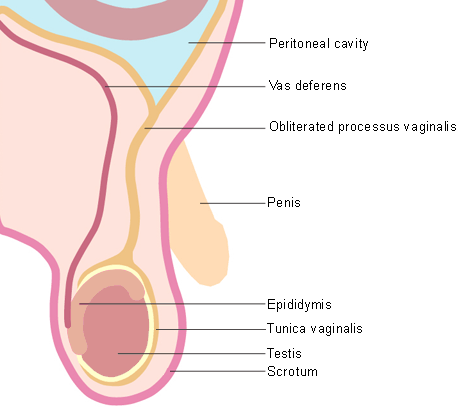
Acute epididymitis is most commonly caused by infection.[1]Taylor SN. Epididymitis. Clin Infect Dis. 2015 Dec 15;61 Suppl 8:S770-3.
https://pubmed.ncbi.nlm.nih.gov/26602616
http://www.ncbi.nlm.nih.gov/pubmed/26602616?tool=bestpractice.com
[4]European Association of Urology. Guidelines on urological infections. Mar 2025 [internet publication].
https://uroweb.org/guidelines/urological-infections
Bacterial epididymitis
The aetiology of bacterial epididymitis is largely dependent on age, sexual practices, and the presence of urinary tract abnormalities or history of instrumentation.[1]Taylor SN. Epididymitis. Clin Infect Dis. 2015 Dec 15;61 Suppl 8:S770-3.
https://pubmed.ncbi.nlm.nih.gov/26602616
http://www.ncbi.nlm.nih.gov/pubmed/26602616?tool=bestpractice.com
[17]Louette A, Krahn J, Caine V, et al. Treatment of acute epididymitis: a systematic review and discussion of the implications for treatment based on etiology. Sex Transm Dis. 2018 Dec;45(12):e104-8.
http://www.ncbi.nlm.nih.gov/pubmed/30044339?tool=bestpractice.com
Among sexually active men of all ages, STI pathogens including Chlamydia trachomatis, Neisseria gonorrhoeae, and Mycoplasma genitalium are common causes of epididymitis.[2]Workowski KA, Bachmann LH, Chan PA, et al. Sexually transmitted infections treatment guidelines, 2021. MMWR Recomm Rep. 2021 Jul 23;70(4):1-187.
https://www.ncbi.nlm.nih.gov/pmc/articles/PMC8344968
http://www.ncbi.nlm.nih.gov/pubmed/34292926?tool=bestpractice.com
Men who have sex with men are at risk of acute epididymitis from enteric organisms (e.g., Escherichia coli) during unprotected insertive anal intercourse.[2]Workowski KA, Bachmann LH, Chan PA, et al. Sexually transmitted infections treatment guidelines, 2021. MMWR Recomm Rep. 2021 Jul 23;70(4):1-187.
https://www.ncbi.nlm.nih.gov/pmc/articles/PMC8344968
http://www.ncbi.nlm.nih.gov/pubmed/34292926?tool=bestpractice.com
In older men (aged >35 years), infection may be due to non-STI with common uropathogens, such as Escherichia coli and Proteus sp.[17]Louette A, Krahn J, Caine V, et al. Treatment of acute epididymitis: a systematic review and discussion of the implications for treatment based on etiology. Sex Transm Dis. 2018 Dec;45(12):e104-8.
http://www.ncbi.nlm.nih.gov/pubmed/30044339?tool=bestpractice.com
In this group, infection may also be associated with other risk factors, such as bladder outlet obstruction, recent instrumentation of the urinary tract, or systemic illness.[1]Taylor SN. Epididymitis. Clin Infect Dis. 2015 Dec 15;61 Suppl 8:S770-3.
https://pubmed.ncbi.nlm.nih.gov/26602616
http://www.ncbi.nlm.nih.gov/pubmed/26602616?tool=bestpractice.com
[2]Workowski KA, Bachmann LH, Chan PA, et al. Sexually transmitted infections treatment guidelines, 2021. MMWR Recomm Rep. 2021 Jul 23;70(4):1-187.
https://www.ncbi.nlm.nih.gov/pmc/articles/PMC8344968
http://www.ncbi.nlm.nih.gov/pubmed/34292926?tool=bestpractice.com
[17]Louette A, Krahn J, Caine V, et al. Treatment of acute epididymitis: a systematic review and discussion of the implications for treatment based on etiology. Sex Transm Dis. 2018 Dec;45(12):e104-8.
http://www.ncbi.nlm.nih.gov/pubmed/30044339?tool=bestpractice.com
The delineation of patients with epididymitis by age is arbitrary, and a degree of crossover exists in terms of aetiology. While some sexual practices are significantly associated with the presence of STIs, half of all STI pathogens were detected in sexually active people who did not report such risks.[18]Pilatz A, Hossain H, Kaiser R, et al. Acute epididymitis revisited: impact of molecular diagnostics on etiology and contemporary guideline recommendations. Eur Urol. 2015 Sep;68(3):428-35.
http://www.ncbi.nlm.nih.gov/pubmed/25542628?tool=bestpractice.com
This highlights the importance of screening all sexually active men with epididymitis for STI pathogens.
Tuberculous epididymitis may occur in endemic areas. The epididymis is a common site of haematogenous implantation of the tuberculosis bacilli following primary pulmonary infection and may remain latent for decades.[19]Yadav S, Singh P, Hemal A, et al. Genital tuberculosis: current status of diagnosis and management. Transl Androl Urol. 2017 Apr;6(2):222-33.
http://tau.amegroups.com/article/view/13854/14808
http://www.ncbi.nlm.nih.gov/pubmed/28540230?tool=bestpractice.com
[20]Gómez García I, Gómez Mampaso E, Burgos Revilla J, et al. Tuberculous orchiepididymitis during 1978-2003 period: review of 34 cases and role of 16S rRNA amplification. Urology. 2010 Oct;76(4):776-81.
http://www.ncbi.nlm.nih.gov/pubmed/20350748?tool=bestpractice.com
Tuberculous epididymo-orchitis is also a rare complication of intravesical BCG therapy for bladder cancer.[19]Yadav S, Singh P, Hemal A, et al. Genital tuberculosis: current status of diagnosis and management. Transl Androl Urol. 2017 Apr;6(2):222-33.
http://tau.amegroups.com/article/view/13854/14808
http://www.ncbi.nlm.nih.gov/pubmed/28540230?tool=bestpractice.com
[21]Liu Y, Lu J, Huang Y, et al. Clinical spectrum of complications induced by intravesical immunotherapy of Bacillus Calmette-Guérin for bladder cancer. J Oncol. 2019;2019:6230409.
https://www.doi.org/10.1155/2019/6230409
http://www.ncbi.nlm.nih.gov/pubmed/30984262?tool=bestpractice.com
Epididymitis is an uncommon complication of brucellosis. Infection with brucella primarily occurs in endemic areas from direct contact with infected animals or ingestion of their non-pasteurised milk.[15]Tracy CR, Steers WD, Costabile R. Diagnosis and management of epididymitis. Urol Clin North Am. 2008 Feb;35(1):101-8;vii.
http://www.ncbi.nlm.nih.gov/pubmed/18061028?tool=bestpractice.com
Other infectious causes
Candidal infection is an uncommon cause of epididymitis. Men at risk of Candida sp. infection are usually immunosuppressed (e.g., diabetes) and have had instrumentation of the urinary tract.[22]Hagley M. Epididymo-orchitis and epididymitis: a review of causes and management of unusual forms. Int J STD AIDS. 2003 Jun;14(6):372-7;quiz 378.
http://www.ncbi.nlm.nih.gov/pubmed/12816663?tool=bestpractice.com
[23]Jenkin GA, Choo M, Hosking P, et al. Candidal epididymo-orchitis: case report and review. Clin Infect Dis. 1998 Apr;26(4):942-5.
https://academic.oup.com/cid/article/26/4/942/415541
http://www.ncbi.nlm.nih.gov/pubmed/9564480?tool=bestpractice.com
Viral epididymitis is rare in the adult population, but an increase of mumps epididymitis was seen in the UK due to the 2005 mumps epidemic in one cohort of non-immunised adults.[5]Gupta RK, Best J, MacMahon E. Mumps and the UK epidemic 2005. BMJ. 2005 May 14;330(7500):1132-5.
https://www.bmj.com/content/330/7500/1132.long
http://www.ncbi.nlm.nih.gov/pubmed/15891229?tool=bestpractice.com
In children, epididymitis may be a post-infectious inflammatory phenomenon following a viral infection.[14]Somekh E, Gorenstein A, Serour F. Acute epididymitis in boys: evidence of a post-infectious etiology. J Urol. 2004 Jan;171(1):391-4.
http://www.ncbi.nlm.nih.gov/pubmed/14665940?tool=bestpractice.com
[24]Gkentzis A, Lee L. The aetiology and current management of prepubertal epididymitis. Ann R Coll Surg Engl. 2014 Apr;96(3):181-3.
https://publishing.rcseng.ac.uk/doi/full/10.1308/003588414X13814021679311?url_ver=Z39.88-2003&rfr_id=ori%3Arid%3Acrossref.org&rfr_dat=cr_pub%3Dpubmed
http://www.ncbi.nlm.nih.gov/pubmed/24780779?tool=bestpractice.com
Non-infectious causes
Rare non-infectious causes of acute epididymitis include a reversible sterile epididymitis resulting from therapy with the antiarrhythmic drug amiodarone, and an association with vasculitic processes in Behçet's syndrome and Henoch-Schönlein purpura.[6]Kanakis MA, Vaiopoulos AG, Vaiopoulos GA, et al. Epididymo-orchitis in Bechet's disease: a review of the wide spectrum of the disease. Acta Med Iran. 2017 Aug;55(8):482-5.
http://acta.tums.ac.ir/index.php/acta/article/view/5798
http://www.ncbi.nlm.nih.gov/pubmed/29034643?tool=bestpractice.com
[7]Modi S, Mohan M, Jennings A. Acute scrotal swelling in Henoch-Schonlein purpura: case report and review of the literature. Urol Case Rep. 2016 Feb 21;6:9-11.
https://www.ncbi.nlm.nih.gov/pmc/articles/PMC4855902
http://www.ncbi.nlm.nih.gov/pubmed/27169017?tool=bestpractice.com
[8]Shen Y, Liu H, Cheng J, et al. Amiodarone-induced epididymitis: a pathologically confirmed case report and review of the literature. Cardiology. 2014 Jun 18;128(4):349-51.
http://www.ncbi.nlm.nih.gov/pubmed/24942374?tool=bestpractice.com
[9]Dasu N, Khalid Y, Panuganti S, et al. Amiodarone induced epididymo-orchitis. Urol Case Rep. 2019 Sep;26:100929.
https://www.sciencedirect.com/science/article/pii/S221444201930141X
http://www.ncbi.nlm.nih.gov/pubmed/31198686?tool=bestpractice.com