The diagnosis of subacute thyroiditis is mainly based on clinical suspicion. Laboratory investigation and imaging studies may sometimes be required to confirm the diagnosis.
Symptoms and signs
Patients often give a history of a relatively abrupt onset of a viral-like illness, with a fever >38°C (100.4°F), myalgia, malaise, and pharyngitis, and accompanying symptoms of thyrotoxicosis, such as palpitations, tremor, and heat intolerance.[1]Nishihara E, Ohye H, Amino N, et al. Clinical characteristics of 852 patients with subacute thyroiditis before treatment. Intern Med. 2008;47(8):725-9.
http://www.ncbi.nlm.nih.gov/pubmed/18421188?tool=bestpractice.com
Neck pain can develop over several days to a few weeks and progress to severe anterior neck pain, overlying the thyroid gland, that may migrate from one side of the neck to the other (termed 'creeping thyroiditis').[27]Arao T, Okada Y, Torimoto K, et al. Prednisolone dosing regimen for treatment of subacute thyroiditis. J UOEH. 2015 Jun 1;37(2):103-10.
https://www.jstage.jst.go.jp/article/juoeh/37/2/37_103/_article
http://www.ncbi.nlm.nih.gov/pubmed/26073499?tool=bestpractice.com
JTA: guideline for the diagnosis of subacute thyroiditis (acute phase)
Opens in new window The pain may radiate to the jaw or the ears and mimic an upper respiratory, a dental, or an ear infection.[4]Ross DS, Burch HB, Cooper DS, et al. 2016 American Thyroid Association guidelines for diagnosis and management of hyperthyroidism and other causes of thyrotoxicosis. Thyroid. 2016 Oct;26(10):1343-421.
https://www.liebertpub.com/doi/10.1089/thy.2016.0229
http://www.ncbi.nlm.nih.gov/pubmed/27521067?tool=bestpractice.com
[28]Toschetti T, Parenti C, Ricci I, et al. Acute suppurative and subacute thyroiditis: from diagnosis to management. J Clin Med. 2025 May 7;14(9):3233.
https://www.mdpi.com/2077-0383/14/9/3233
http://www.ncbi.nlm.nih.gov/pubmed/40364264?tool=bestpractice.com
Clinical evaluation
On examination, the patient typically appears ill, has tachycardia, and has an enlarged, firm, and exquisitely tender thyroid gland.
The thyrotoxic phase of the disease may reach its peak within 3-4 days, then subside and disappear within a week. More typically, its onset is gradual and extends over 1-2 weeks, after which the condition continues with a fluctuating intensity for up to 3 months.[2]Fatourechi V, Aniszewski JP, Fatourechi GZ, et al. Clinical features and outcome of subacute thyroiditis in an incidence cohort: Olmsted county, Minnesota, study. J Clin Endocrinol Metab. 2003 May;88(5):2100-5.
http://www.ncbi.nlm.nih.gov/pubmed/12727961?tool=bestpractice.com
ATA: thyroiditis
Opens in new window
Occasionally, patients may:[5]Mizokami T, Okamura K, Sato K, et al. Localized painful giant-cell thyroiditis without inflammatory signs in a euthyroid patient followed by serial sonography. J Clin Ultrasound. 1998 Jul-Aug;26(6):329-32.
http://www.ncbi.nlm.nih.gov/pubmed/9641397?tool=bestpractice.com
present with fever of unknown origin or thyrotoxic symptoms, but no pain or viral-like illness
be asymptomatic, with high serum thyroid hormone levels
rarely, present with a firm thyroid but without fever or pain, or just with biochemical thyrotoxicosis.
Initial investigations
Laboratory tests include full blood count, C-reactive protein (CRP) and/or erythrocyte sedimentation rate (ESR), and thyroid function tests when acute thyroiditis is suspected.[28]Toschetti T, Parenti C, Ricci I, et al. Acute suppurative and subacute thyroiditis: from diagnosis to management. J Clin Med. 2025 May 7;14(9):3233.
https://www.mdpi.com/2077-0383/14/9/3233
http://www.ncbi.nlm.nih.gov/pubmed/40364264?tool=bestpractice.com
Full blood count: mild anaemia and elevation of the WBC count are common.[4]Ross DS, Burch HB, Cooper DS, et al. 2016 American Thyroid Association guidelines for diagnosis and management of hyperthyroidism and other causes of thyrotoxicosis. Thyroid. 2016 Oct;26(10):1343-421.
https://www.liebertpub.com/doi/10.1089/thy.2016.0229
http://www.ncbi.nlm.nih.gov/pubmed/27521067?tool=bestpractice.com
[28]Toschetti T, Parenti C, Ricci I, et al. Acute suppurative and subacute thyroiditis: from diagnosis to management. J Clin Med. 2025 May 7;14(9):3233.
https://www.mdpi.com/2077-0383/14/9/3233
http://www.ncbi.nlm.nih.gov/pubmed/40364264?tool=bestpractice.com
JTA: guideline for the diagnosis of subacute thyroiditis (acute phase)
Opens in new window
CRP: non-specific marker of inflammation, raised
ESR: non-specific marker of inflammation, raised
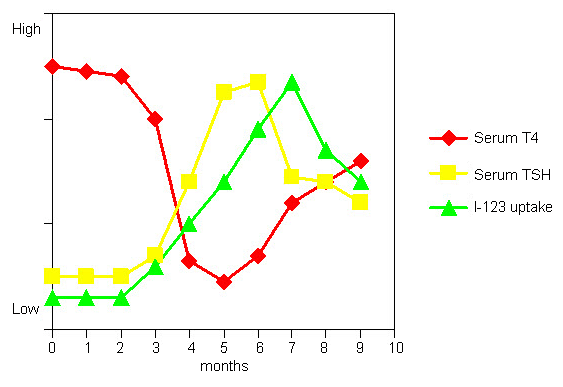
Thyroid function tests: during the initial thyrotoxic phase, serum triiodothyronine (T3) and thyroxine (T4) levels are raised; thyroid-stimulating hormone (TSH) is suppressed (<0.01 mIU/L).[4]Ross DS, Burch HB, Cooper DS, et al. 2016 American Thyroid Association guidelines for diagnosis and management of hyperthyroidism and other causes of thyrotoxicosis. Thyroid. 2016 Oct;26(10):1343-421.
https://www.liebertpub.com/doi/10.1089/thy.2016.0229
http://www.ncbi.nlm.nih.gov/pubmed/27521067?tool=bestpractice.com
[28]Toschetti T, Parenti C, Ricci I, et al. Acute suppurative and subacute thyroiditis: from diagnosis to management. J Clin Med. 2025 May 7;14(9):3233.
https://www.mdpi.com/2077-0383/14/9/3233
http://www.ncbi.nlm.nih.gov/pubmed/40364264?tool=bestpractice.com
As the thyroiditis progresses to the hypothyroid phase, the serum T4 will be low while the TSH may be variable, but usually raised or normal. In the final recovery phase, most patients return to normal serum thyroid function.
Imaging studies
Include scintigraphy and ultrasonography.
Radioactive iodine uptake (RAIU)
Reliably confirms the diagnosis of subacute hypothyroiditis in the thyrotoxic phase. RAIU can be obtained if the clinical presentation and serum thyroid function tests are not sufficient for diagnosis.
In the thyrotoxic phase, scintigraphy demonstrates low thyroidal uptake (I-123 or 99mTc-pertechnetate), typically <1% to 3% at 24 hours.[4]Ross DS, Burch HB, Cooper DS, et al. 2016 American Thyroid Association guidelines for diagnosis and management of hyperthyroidism and other causes of thyrotoxicosis. Thyroid. 2016 Oct;26(10):1343-421.
https://www.liebertpub.com/doi/10.1089/thy.2016.0229
http://www.ncbi.nlm.nih.gov/pubmed/27521067?tool=bestpractice.com
[9]Mariani G, Tonacchera M, Grosso M, et al. The role of nuclear medicine in the clinical management of benign thyroid disorders, part 2: nodular goiter, hypothyroidism, and subacute thyroiditis. J Nucl Med. 2021 Jul 1;62(7):886-95.
https://www.doi.org/10.2967/jnumed.120.251504
http://www.ncbi.nlm.nih.gov/pubmed/33579801?tool=bestpractice.com
Other aetiologies associated with thyroid pain, such as a cystic or haemorrhagic nodule or infection in the thyroid, would typically present with normal thyroid function, normal radioactive iodine uptake, and a thyroid scan showing a cold area corresponding with the cyst or infection.
Note that patients with potentially fatal acute suppurative thyroiditis may be biochemically thyrotoxic with low radioiodine uptake during the thyrotoxic phase.[29]Falhammar H, Wallin G, Calissendorff J. Acute suppurative thyroiditis with thyroid abscess in adults: clinical presentation, treatment and outcomes. BMC Endocr Disord. 2019 Dec 3;19(1):130.
https://bmcendocrdisord.biomedcentral.com/articles/10.1186/s12902-019-0458-0
http://www.ncbi.nlm.nih.gov/pubmed/31791298?tool=bestpractice.com
[30]Lafontaine N, Learoyd D, Farrel S, et al. Suppurative thyroiditis: systematic review and clinical guidance. Clin Endocrinol (Oxf). 2021 Aug;95(2):253-64.
https://onlinelibrary.wiley.com/doi/10.1111/cen.14440
http://www.ncbi.nlm.nih.gov/pubmed/33559162?tool=bestpractice.com
Thyroid ultrasound
Patients with painful subacute thyroiditis have areas of poorly defined heterogenous hypoechoic echotexture, with irregular margins in the areas of the thyroid gland that are painful.[1]Nishihara E, Ohye H, Amino N, et al. Clinical characteristics of 852 patients with subacute thyroiditis before treatment. Intern Med. 2008;47(8):725-9.
http://www.ncbi.nlm.nih.gov/pubmed/18421188?tool=bestpractice.com
[4]Ross DS, Burch HB, Cooper DS, et al. 2016 American Thyroid Association guidelines for diagnosis and management of hyperthyroidism and other causes of thyrotoxicosis. Thyroid. 2016 Oct;26(10):1343-421.
https://www.liebertpub.com/doi/10.1089/thy.2016.0229
http://www.ncbi.nlm.nih.gov/pubmed/27521067?tool=bestpractice.com
[28]Toschetti T, Parenti C, Ricci I, et al. Acute suppurative and subacute thyroiditis: from diagnosis to management. J Clin Med. 2025 May 7;14(9):3233.
https://www.mdpi.com/2077-0383/14/9/3233
http://www.ncbi.nlm.nih.gov/pubmed/40364264?tool=bestpractice.com
[31]Omori N, Omori K, Takano K. Association of the ultrasonographic findings of subacute thyroiditis with thyroid pain and laboratory findings. Endocr J. 2008 Jul;55(3):583-8.
http://www.ncbi.nlm.nih.gov/pubmed/18490832?tool=bestpractice.com
[32]Frates MC, Marqusee E, Benson CB, et al. Subacute granulomatous (de Quervain) thyroiditis: grayscale and color Doppler sonographic characteristics. J Ultrasound Med. 2013 Mar;32(3):505-11.
http://www.ncbi.nlm.nih.gov/pubmed/23443191?tool=bestpractice.com
[33]Pan FS, Wang W, Wang Y, et al. Sonographic features of thyroid nodules that may help distinguish clinically atypical subacute thyroiditis from thyroid malignancy. J Ultrasound. 2015;34:689-96.
http://www.ncbi.nlm.nih.gov/pubmed/25792585?tool=bestpractice.com
[34]Li JH, Daniels GH, Barbesino G. Painful subacute thyroiditis is commonly misdiagnosed as suspicious thyroid nodular disease. Mayo Clin Proc Innov Qual Outcomes. 2021 Apr;5(2):330-37.
https://www.doi.org/10.1016/j.mayocpiqo.2020.12.007
http://www.ncbi.nlm.nih.gov/pubmed/33997632?tool=bestpractice.com
Normal or decreased flow may be evident on color Doppler ultrasound.[1]Nishihara E, Ohye H, Amino N, et al. Clinical characteristics of 852 patients with subacute thyroiditis before treatment. Intern Med. 2008;47(8):725-9.
http://www.ncbi.nlm.nih.gov/pubmed/18421188?tool=bestpractice.com
Ultrasound is not sufficiently specific to confirm the diagnosis of subacute thyroiditis; findings can be similar to the sonographic appearance of chronic thyroiditis or suspicious thyroid nodules.[34]Li JH, Daniels GH, Barbesino G. Painful subacute thyroiditis is commonly misdiagnosed as suspicious thyroid nodular disease. Mayo Clin Proc Innov Qual Outcomes. 2021 Apr;5(2):330-37.
https://www.doi.org/10.1016/j.mayocpiqo.2020.12.007
http://www.ncbi.nlm.nih.gov/pubmed/33997632?tool=bestpractice.com
Ultrasound should not, therefore, be used alone for the diagnosis of subacute thyroiditis.
Ultrasound elastography demonstrates that subacute thyroiditis lesions may have an elevated baseline elasticity score compared with benign nodules of a multinodular goitre or chronic autoimmune thyroiditis.[35]Xie P, Xiao Y, Liu F. Real-time ultrasound elastography in the diagnosis and differential diagnosis of subacute thyroiditis. J Clin Ultrasound. 2011 Oct;39(8):435-40
http://www.ncbi.nlm.nih.gov/pubmed/21674511?tool=bestpractice.com
[36]Ruchala M, Szczepanek-Parulska E, Zybek A, et al. The role of sonoelastography in acute, subacute and chronic thyroiditis: a novel application of the method. Eur J Endocrinol. 2012 Mar;166(3):425-32.
http://www.ncbi.nlm.nih.gov/pubmed/22143319?tool=bestpractice.com
However, this imaging modality was unable to distinguish between subacute thyroiditis and thyroid cancer in one study.[35]Xie P, Xiao Y, Liu F. Real-time ultrasound elastography in the diagnosis and differential diagnosis of subacute thyroiditis. J Clin Ultrasound. 2011 Oct;39(8):435-40
http://www.ncbi.nlm.nih.gov/pubmed/21674511?tool=bestpractice.com
Biopsy is rarely required
Biopsy is not routinely performed.[4]Ross DS, Burch HB, Cooper DS, et al. 2016 American Thyroid Association guidelines for diagnosis and management of hyperthyroidism and other causes of thyrotoxicosis. Thyroid. 2016 Oct;26(10):1343-421.
https://www.liebertpub.com/doi/10.1089/thy.2016.0229
http://www.ncbi.nlm.nih.gov/pubmed/27521067?tool=bestpractice.com
Diagnosis of subacute thyroiditis may be made premised on clinical history, physical examination, laboratory data and, if needed, RAIU.[4]Ross DS, Burch HB, Cooper DS, et al. 2016 American Thyroid Association guidelines for diagnosis and management of hyperthyroidism and other causes of thyrotoxicosis. Thyroid. 2016 Oct;26(10):1343-421.
https://www.liebertpub.com/doi/10.1089/thy.2016.0229
http://www.ncbi.nlm.nih.gov/pubmed/27521067?tool=bestpractice.com
Cytology (fine needle aspiration biopsy) may be useful to confirm a clinical diagnosis in the setting of:
high iodine intake (e.g., a patient who recently received iodinated contrast for a radiologic scan [within the past 2 months, approximately])
recent use of an iodine-rich drug (e.g., amiodarone [within the past 6 months, approximately).
Saturation of the thyroid's capacity to absorb radioactive iodine in these scenarios can lead to falsely low uptake.
Cytological features consistent with subacute thyroiditis include multinucleated giant cells, degenerated follicular epithelium cells, epithelioid granulomas, and mixed inflammatory cells.[37]Sahin D, Akpolat İ. Diagnostic cytological features and differential diagnosis of subacute granulomatous (De Quervain's) thyroiditis. Diagn Cytopathol. 2019 Dec;47(12):1251-8.
http://www.ncbi.nlm.nih.gov/pubmed/31368258?tool=bestpractice.com
[38]Lamichaney R, Sherpa M, Das D, et al. Fine-needle aspiration of de quervain's thyroiditis (subacute granulomatous thyroiditis): a cytological review of 20 cases. J Clin Diagn Res. 2017 Aug;11(8):EC09-11.
https://pmc.ncbi.nlm.nih.gov/articles/PMC5620773
http://www.ncbi.nlm.nih.gov/pubmed/28969133?tool=bestpractice.com
[Figure caption and citation for the preceding image starts]: I-123 radioactive iodine scan showing absence of thyroid uptake in the thyrotoxic phase of subacute thyroiditis; arrow indicates sternal notch markerFrom the personal collection of Dr Stephanie Lee [Citation ends]. [Figure caption and citation for the preceding image starts]: Clinical course of subacute thyroiditis: measurements of serum TSH, serum T4, and I-123 thyroid uptake during thyrotoxic, hypothyroid, and euthyroid phasesCreated by Dr Stephanie Lee [Citation ends].