Case history
Case history #1
During a trip to France, a 24-year-old woman consumes slabs of raw, uncured ham from a wild boar.[4] Three days later, she develops nausea, vomiting, and diarrhoea, which subsides with the use of loperamide. Two weeks later, she presents to the emergency department with fever, a diffuse maculopapular rash, severe myalgia, and marked peri-orbital oedema. On examination, in addition to the facial oedema, splinter haemorrhages are noted. Laboratory examination reveals marked eosinophilia and elevation of creatine kinase. The presumptive diagnosis is trichinellosis and the patient is offered treatment with albendazole but declines to take it. One week later, a serum antibody for Trichinella species is positive. The patient is contacted and refuses a muscle biopsy. The patient has persistent myalgias for about 5 weeks, but eventually has a full recovery.[Figure caption and citation for the preceding image starts]: Trichinellosis manifested by splinter haemorrhages under the finger nailsCDC/Dr Thomas F. Sellers/Emory University [Citation ends].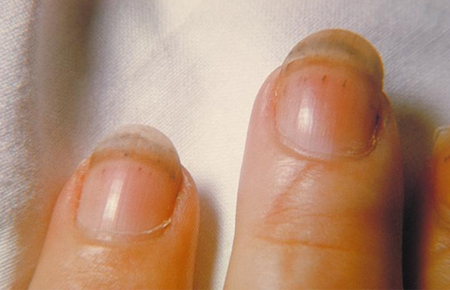
Case history #2
After shooting and killing a cougar (Felis concolor) in Idaho, a 45-year-old man prepares jerky by soaking the cougar meat in a salty solution and then smoking it.[5] He later reports that the smoker never became more than warm. Three weeks after ingesting the jerky, he develops fever, severe myalgia, facial swelling, and fatigue. A full blood count shows 10,000 white blood cells/microlitre with marked eosinophilia (40%), and a muscle biopsy confirms the diagnosis of trichinellosis. The patient is treated with albendazole and recovers well. Five of the ≥20 people who also consumed the jerky develop a similar syndrome and are confirmed to have trichinellosis by serum antibodies. A further three people have positive antibodies but with a sub-clinical course.
Other presentations
Patients may present with a complication of trichinellosis, such as myocarditis or central nervous system involvement. Trichinella myocarditis may present with chest pain, palpitations, dyspnoea, and lower extremity oedema secondary to congestive cardiac failure. The clinical manifestations of neurotrichinellosis include severe headache, muscular weakness, hyporeflexia, tinnitus, vertigo, deafness, aphasia, seizures, apathy, insomnia, a paralysis-like state, meningitis, encephalitis, polyradiculoneuritis, poliomyelitis, myasthenia gravis, paresis, and sinus thrombosis.[6][7]
Use of this content is subject to our disclaimer