Criteria
European Academy of Neurology/Peripheral Nerve Society criteria for motor-sensory or motor Guillain-Barre syndrome[15]
Several sets of published diagnostic criteria for Guillain-Barre syndrome (GBS) are available. The European Academy of Neurology/Peripheral Nerve Society (EAN/PNS) recommends the following.
Required features
Progressive weakness in both arms and legs
Areflexia (or hyporeflexia) in affected limbs
Progressive worsening for no more than 4 weeks
Features supportive of diagnosis
Relative symmetry
Mild or absent sensory signs or symptoms
Cranial nerve involvement, especially bilateral facial weakness
Autonomic dysfunction
Respiratory insufficiency (due to muscle weakness)
Pain (muscular/radicular in back or limb)
Recent history of infection (within <6 weeks) or possibly surgery
Typical cerebrospinal fluid (CSF) and electromyogram/nerve conduction studies features
Positive anti-GQ1b antibodies in Miller-Fisher syndrome
Features that make GBS less likely
Marked and persistent asymmetrical weakness
Severe respiratory dysfunction at onset with mild limb weakness
Predominant sensory signs at onset (paraesthesias often occur) with mild weakness
Fever at onset
Sensory level or extensor plantar responses
Hyperreflexia (initial hyperreflexia does not exclude GBS)
Bladder or bowel dysfunction (does not exclude GBS)
Abdominal pain or vomiting
Nystagmus
Alteration of consciousness (except in Bickerstaff brainstem encephalitis)
Abnormal routine blood tests (hyponatraemia may occur in GBS)
>50 cells/mm³ mono- or polymorphonuclear cells in CSF
No further worsening after 24 hours
Relatively slow worsening (2-4 weeks) with mild weakness
Continued worsening >4 weeks or ≥3 treatment-related fluctuations (suggests acute-onset chronic inflammatory demyelinating polyradiculoneuropathy)
The EAN/PNS guideline also highlights some ther commonly used criteria including the revised National Institute of Neurological Disorders and Stroke (NINDS) criteria, the Brighton Collaboration consensus criteria, and the Leonhard et al. consensus criteria.[21][90][158]
Electrophysiological classification of Guillain-Barre syndrome[113][116]
Neurophysiological criteria for acute inflammatory demyelinating polyradiculoneuropathy (AIDP), acute motor-sensory axonal neuropathy (AMSAN), and acute motor axonal neuropathy (AMAN).
At least 3 sensory nerves and 3 motor nerves with multi-site stimulation F waves, and bilateral tibial H reflexes, need to be evaluated.
AIDP
At least 1 of the following in each of at least 2 nerves, or at least 2 of the following in 1 nerve if all others inexcitable and distal compound muscle action potential (dCMAP) >10% lower limit of normal (LLN):
Motor conduction velocity <90% LLN (85% if dCMAP <50% LLN)
Distal motor latency >110% upper limit of normal (ULN) (>120% if dCMAP <100% LLN)
Proximal compound muscle action potential (pCMAP)/dCMAP ratio <0.5 and dCMAP >20% LLN
F-response latency >120% ULN.
Newer criteria have been proposed for AIDP, which increase the sensitivity of diagnosis, and include:[117]
At least 1 of the following in at least 2 nerves: motor conduction velocity <70% LLN; distal motor latency >150% ULN; F-response latency >120% ULN, or >150% ULN (if distal CMAP <50% of LLN); or
F-wave absence in 2 nerves with dCMAP ≥20% LLN or greater, with an additional parameter, in 1 other nerve; or
pCMAP/dCMAP ratio <0.7 (excluding the tibial nerve) in 2 nerves, with an additional parameter in 1 other nerve.
AMSAN
Diminution of muscle and sensory action potentials[103]
None of the features of AIDP except 1 demyelinating feature allowed in 1 nerve if dCMAP <10% LLN
Sensory action potential amplitudes less than LLN.
AMAN
Reduction in distally evoked motor action potential amplitudes, early signs of denervation on needle, normal action potential on sensory nerves, and relatively preserved motor nerve conduction velocity.[64][73][74]
None of the features of AIDP except 1 demyelinating feature allowed in 1 nerve if dCMAP <10% LLN
Sensory action potential amplitudes normal.
Inexcitable
dCMAP absent in all nerves or present in only 1 nerve with dCMAP <10%.
Miller-Fisher syndrome
Reduced or absent sensory action potential response without slowing of sensory conduction velocity.[159]
Electrodiagnostic criteria for acute inflammatory demyelinating polyradiculoneuropathy[160]
Different sets of criteria have been published, including the following (sensitivity 64% to 72%):
150% prolongation of motor distal latency above ULN
70% slowing of motor conduction velocity below LLN
125% (150% if the distal negative-peak CMAP amplitude was 80% of LLN) prolongation of F wave latency above ULN
Abnormal temporal dispersion (peak CMAP duration increase) in ≥2 nerves.
GBS disability scale (Hughes scale)[161]
0 - healthy
1 - minor symptoms or signs of neuropathy but capable of manual work
2 - able to walk without support of a stick but incapable of manual work
3 - able to walk with a stick, appliance, or support
4 - confined to bed or chair-bound
5 - requiring assisted ventilation
6 - dead
Modified Erasmus GBS Outcome Score (EGOS) at hospital admission[162]
Clinical prediction model that can be applied early in the course of disease (on admission or at 7 days) to predict the probability of being unable to walk independently during the first 6 months of follow up. Based on three questions:
age at onset of neurological symptoms: ≤40 years; 41-60 years; >60 years
preceding diarrhoea: absent or present
severity of muscle weakness (at hospital admission, and at day 7 of admission) defined by the Medical Research Council (MRC) sum score: 0 to 30; 31 to 40; 41 to 50; 51 to 60.
The model can be used at hospital admission as a 9-point scale and at day 7 of admission as a 12-point scale. The total score is converted to a corresponding risk of being unable to walk independently at 4 weeks and 6 months using probability graphs or via an online tool.[163]
Erasmus GBS Respiratory Insufficiency Score (EGRIS)[164]
Clinical prediction model to predict the probability of respiratory insufficiency within the first week of admission. Based on three questions:
number of days between onset and hospital admission: >7 days; 4-7 days; ≤3 days
facial and/or bulbar weakness: present or absent
severity of muscle weakness defined by the MRC sum score: 0 to 20; 21 to 30; 31 to 40; 41 to 50; 51 to 60.
The total score (0 to 7) is converted to a corresponding risk of respiratory insufficiency using probability graphs or via an online tool.[133]
Identification of patients with GBS at risk of respiratory failure using the 20/30/40 rule[128]
In patients with no bulbar dysfunction, or with mild bulbar dysfunction without aspiration risk, the 20/30/40 rule should be used.
Intensive care unit monitoring and elective intubation should be considered if any of the following is present:
Vital capacity <20 mL/kg (odds ratio 15.0)
Maximal inspiratory pressure worse than -30 cmH₂O
Maximal expiratory pressure <40 cmH₂O
Reduction of 30% or more of vital capacity, maximal inspiratory pressure, or maximal expiratory pressure.
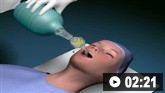 Tracheal intubation animated demonstration
How to insert a tracheal tube in an adult using a laryngoscope.
 Bag-valve-mask ventilation animated demonstration
How to use bag-valve-mask apparatus to deliver ventilatory support to adults. Video demonstrates the two-person technique.
Use of this content is subject to our disclaimer